



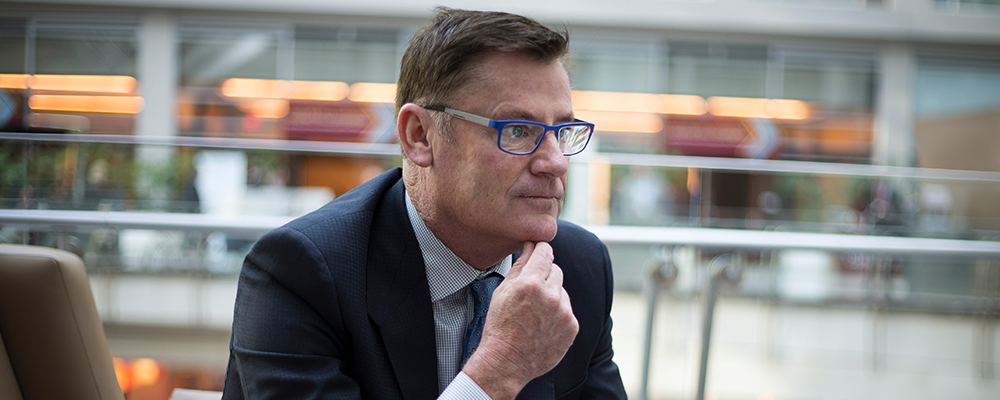
Meet Dan Madsen, chairman & CEO of Seattle-based Leisure Care. Over the course of his 28-year career in senior living, Madsen has grown his role within Leisure Care from being the general manager of one community to being an owner. Paying close attention to hospitality organizations, Madsen has helped shape various brands under the company including expansion overseas. With a philosophy around putting people first, he has grown the culture of the company with a close focus on its employees. We sat down with Madsen to learn about the company’s mantra: Family, philanthropy and business; why he sees opportunity in other countries; and how his hotel stays lead to big ideas for senior living.
Spotlight on Technology
What technology do you think is important for senior living providers today?
Wi-Fi.It’s shocking how many people don’t have it. I think the demand is high. At our Treeo projects, when people move in, they get an iPad as part of their move-in. Not a microwave—an iPad. We have an iPad posted on a stand in the lobby as a virtual concierge. Hotels have been doing it forever. We have our own app—internal and external—so families can log into that app and see what’s going on, and our residents can communicate through it. It’s what pops up on the screen when they all come in in the morning, and they can see those things and get right to their families and emails.
Are people using it?
People are using it a lot. We have classes [for using the iPad]. It’s been a lot of fun.
Are you going to roll that out at all of your communities?
Wi-Fi for sure. Connectivity is key, just like it is for us; why would it be any different for residents?
Aside from Wi-Fi, what other technology do you think communities need?
I have always liked safety systems. Wearables—I’ve gotta track my steps! We’re in competition at our company. We chart it on a big board. Our residents do it too. We have competition among different communities; it’s fun.
What do you think is going to be the driving force getting operators to adopt technology?
High demand from family members and residents themselves. We’re in the generation now that are moving in with demands; they’re walking around with laptops. It’s not yesterday’s retirement community where there wasn’t any technology. We’ve now had computers, we’ve now had mobile devices… It’s going to attract a more independent resident, I think.
Tell me about how you got into senior living.
I got into senior living 28 years ago this past July. Basically, I needed a job and I started out managing a Leisure Care retirement community that was in trouble and needed a lot of help. There was very low employee morale, and it was financially distraught. I got lucky to have an opportunity where I could only go up from there. I was certainly entrepreneurial, but I was only 26 years old.
What made that an exciting opportunity?
It was moving away from what I was doing, and moving to an area where there were good people involved that cared about family and human beings.
What position did you start in?
I was a general manager.
How many communities did Leisure Care have at that point?
Around 15.
What did you notice when you started to take over? What did you need to fix?
This has been my philosophy for 28 years: Start with employees first. Assess the situation, assess employee morale. Great customer service is a result of giving great service to your employees first.
Was it hard to win people over?
It was. Those were sleepless nights back then. I think I knew what to do, but I tore in one by one and started keeping promises, demonstrating leadership through activity and action. I was changing the lightbulbs and painting the hallways, too. I think that made a big difference.
How long did it take before you started to see some results?
It was fairly immediate. We were really starting to roll at about six months.
After being general manager, where did you go?
I was promoted to a corporate position at area operations overseeing two to three projects. It was kind of an operations director-in-training role. Then I just kind of moved up.
You have a lot of different brands. In June of 2008 you launched Leisure Care 180, which seems to have shifted to a hospitality model in a big way. Is that fair?
I think that’s really fair. I bought the company in 2003, going from general manager to owner. We had always been hospitality driven, but 180 allowed us to take some of our products and services and virtually integrate them into Leisure Care. Our travel company, for example, sat as a line item. So when we moved it off of the books, we stayed vertically integrated.
How’d you get the opportunity to purchase the company?
I had a great relationship with the previous owners, and still manage their properties. It was a split between real estate and management. They were my original bosses and we grew together over all of those years. It became good succession planning for them and a good opportunity for me. We spent quality time designing how it would work best for all of us so that I could fly, and they could feel stable and secure with the management they had trained.
I think you may be the only senior living provider that has a travel agency. How did you come up with that?
We travel a lot, so there was part of us that said “Geez, we’re paying a lot of fees. If we do this on our own, we can also do executive travel for other people in town—friends, banks, lenders and people we do business with.” The idea was to have the program, a profit center, but then to integrate it back into what we do with our residents. That goes back to hospitality. We do senior escorted travel all over the world. I just got back two weeks ago from a ‘President’s Cruise,’ we call it, in Alaska. A couple dozen residents come from different communities and go on a seven day cruise together. We dine, we play, we excursion, we do it all together. It’s not a travel program like most.
With so many brands, are there challenges to managing them all?
Not at all. We have different leaders. I think some of our products were branded because there are different styles of retirement communities, too. I would liken it to the hotel industry. You have the JW Marriott, then you have the Marriott Marquis and Fairfield Inn & Suites by Marriott.
So you’ve taken a lot of inspiration from the hotel industry?
Sure! They did it long before we did.
You also have some international communities that are opening up.
Yes, we’re opening one in India [right now]. Anywhere we go internationally, we partner with local executives and owners and partners that know that business, culture and so on. We don’t try to do it ourselves. We provide the operations expertise, and let them handle the development side.
Why India?
It kind of came to us. This group of great folks came over to the U.S., they interviewed several companies and we decided to help them out on a consulting basis. As we went to India and explored the opportunities, we saw that this could be much more than that. It’s not always about teaching, it’s about listening.
And Mexico?
Mexico as well. We also have a project in London, we’re working with a group there called Elysian, so we’re really looking forward to that.
Is it private pay?
Private pay everywhere, high end.
LEADERSHIP
What’s your definition of leadership?
It’s really believing in who you are and being committed to it and demonstrating it in every phase of your life so it’s unwavering. Right, wrong or indifferent from an outside perspective, people know who you are and they’ll either follow and work with you, or they won’t. When you find that you have traction, that’s when it gets fun.
Do you think your definition of leadership has changed over the years?
No, I think it was probably learned when I first started, 28 years ago. I came from an environment without [a definition of leadership] and it was clear to me that I needed to find who I was, and I needed to find people with that type of character, those types of morals that would stand strong and have the posture and be able to fight off any temptation for doing bad things or being greedy.
It sounds like you learned what not to do at your job.
That’s probably the best way to look at it.
Looking at it that way, was that a good experience for you?
It was an amazing experience! As painful as it was, it was amazing because you really have to commit to something and say “No, I really believe that family’s first.” We have a mantra, it’s pretty simple: Family, philanthropy and business—in that order. That’s our lifestyle, and we don’t change. We haven’t changed since I’ve been around.
During your time, what’s been the biggest challenge Leisure Care has faced, and how did you overcome it?
The biggest challenge we’ve faced as a company is actually a pretty big benefit. We tend to have a culture that grows executives and gives people opportunities; we have a very low turnover in our company, and people tend to stay with us a long time. One of the greatest challenges that we have is providing enough growth opportunity for people to continue to grow and allow them opportunities. We have a team of great folks ready to go.
How is that a challenge?
The challenge is that you have to be disciplined to manage growth in a disciplined way. [You have to] strike the balance between growing so that people have opportunities, and continuing to keep people supported. That’s the tricky part. It’s a sophisticated problem, but it’s a good one to have.
What was the hardest time?
This last recession. It shocked everybody, and this was the first time we realized our industry was not recession-proof. We had touted for years, “We’re recession-proof,” but we weren’t. The houses didn’t sell. People lost their wealth, they lost the value in their homes. Banks weren’t lending. All of a sudden the census drops.
What did you learn from that experience?
Leverage. Make sure that you’re properly leveraged, not over-leveraged, that you have cash in the till so you can get through the rough times. I watched some companies, not just in our industry, but others, that reacted desperately during those times. When you’re acting desperately you do things that you shouldn’t do, and you take measures that you shouldn’t take—whether it’s layoffs of key personnel, cutting costs and doing things that aren’t good for your residents or your staff or your brand.
With all of the different brands, does it help manage risk? If one’s not doing well, maybe another one will be doing better?
Yes. Absolutely. With our various brands and various projects, they’re priced differently, and they’re serviced differently, much like the hotel industry. You have turndown service at one, and at another one you don’t. So we found that during the recession, the mid-market really stayed stable. That’s our Treeo buildings and our Fairwinds buildings. Our higher end buildings were the ones that had a challenge.
Do you think senior living providers have the opportunity to create a real middle market product? That seems to be the golden ticket right now.
I do. We have a great mid-market product. We started from design and construction and some of those things, and it was inhibiting our ability. We’d buy expensive land, we had expensive costs and construction and then we’d have to price accordingly. The difference with Treeo was we started with the price point for our market, and we built to that. We didn’t just focus on the design and construction; we looked at operations and how we may efficiently operate the building so we can stay right in that market.
How do you test products like that? Do you build one, and find out what works?
Yes, what did or didn’t work. I learned from a good mentor of mine in the industry that you just have to get started.
So what did you find that didn’t work?
As we were looking at conservative pricing, it drew us to conservative markets in some cases. In conservative markets, sometimes people take longer to make decisions.
When you say conservative markets, do you mean non-major metropolitan areas?
Correct. When you look at a certain personality profile that you’re marketing to that may have the wealth, but they’re not going to spend the wealth—they’re going to find a price point that they’re comfortable with. They don’t stay at the high end hotels. We were finding a lot of those folks in conservative markets. They act conservatively, so it’s a longer fill, but then you have really committed and passionate residents. So we’d add six months to a fill in some of those markets, but then the residents stay longer. A really neat thing with that product was how many more men we attracted to Treeo.
Really? Why do you think that is?
It’s fun—bright colors, a lot of energy, the focus is on independence.
Single men?
And couples. Both.
With the middle market product, in order to keep it affordable, are you planning on bringing services into the community? Or when residents need more assistance, are they going to have to move out of those communities?
We have home health, so we can handle it, to a certain level. But we want to keep it independent. A lot of it is the use of space as well. Dining rooms and restaurants in our business stay empty the majority of the day, so we want to be able to utilize those spaces for activities and other things throughout the day. Our front desk is a bar and bistro, which just made sense. Instead of looking across the hallway at an empty bistro, we always have a front desk person, so now we always have a bartender. Now the front desk is more functional. There’s a sliding door to the kitchen.
So where do you get the inspiration? It feels very hotel-ish.
It is. I stay in a lot of them.
Do you ever stay in a hotel and think, ‘We could do this!’?
Oh yeah! All good ideas are copied from somewhere. You’re constantly doing research. Family members are going to evaluate us based on their last hospitality experience. I like to compete with the last great hospitality experience that either a resident or family member had—not my [senior housing] competition.
Are you starting to do more developing in urban areas?
We like it and we’d like to do more of it. I believe in the model, because I see all of the folks moving back downtown, and it’s a neat opportunity with all of the amenities that are there. I don’t have to build a theater, we don’t have to build a lot of restaurants, we have access to lots of services.
Can you do it at a price point that makes sense?
I think if you can get creative, then you can at least become competitive in those markets.
What’s the biggest risk you’ve taken in your career?
Buying the company was probably by far the biggest risk. It was mitigated because it was a company I was running from a CEO perspective, but I didn’t know what was under the table. That was in my late 30s, but I had a lot of support and executives I trusted around me.
What’s the best piece of advice you’ve received in your career?
Relax. I believe that you keep your commitments, stay focused and relax. I’m not very good at relaxing. I’m very relaxed about the business, but I’m not a relaxed person. I have a lot of energy and I like to get after things.
Who would you consider to be your mentor, and how have they helped your career?
I’ve had various mentors for different things. I’ve had some good advice to put my own personal board together—the people around me I’m going to seek advice from. I think my dad was my greatest mentor by far.
How so?
He had a very good philosophy which I try to do as well: Make a positive impact on everybody you meet every day. Leave them better than you found them. He just lived that way.
What would you say some of your greatest strengths are as a leader?
Consistency. Values. Character. Energy.
You’ve used the word ‘family.’ I’m curious, how do you implement those values in your day-to-day company?
That’s probably the best part of the job. You hear companies that say “Family first” all the time. As a leader, you must do it. You must leave at 2:00 p.m. and go to your son’s baseball game. You need to go care for mom and dad, you need to take family time when needed. You need to support executives when they need to stay home with their kids because they have daycare issues or whatever it might be, and we don’t define ‘family.’ Some people have pets not kids, and that’s family. It’s undefined, but it’s supportive of one’s personal life and one’s personal pursuit of life. Sometimes they take longer vacations than they’ve earned and they’re going to go and climb a mountain, and I think it’s important that we support healthy lifestyles. We have to do it too.
For you as a leader, do you have to do that as well?
I do. Absolutely. It’s not something you do in a week. It takes a decade of that kind of commitment. When it becomes habitual, where you’re no longer in control of it, is the fun part because that’s when you’ve created an environment that attracts family-first people. We believe in focusing on what creates results, and that’s a healthy lifestyle for you personally; it’s a healthy work environment, it’s fun, has high energy. It’s focused on the right things. It’s focused on family, philanthropy and business. When those other two are rolling, business is good. It just is.
What would you consider your greatest weaknesses?
Sometimes a lack of risk. Sometimes I get more conservative than I should be. I’m getting better at it. I would say one of them is patience. I’ve had to work on patience to get things done. Sometimes it needs to happen on its own time, its own pace.
Do you think your risk tolerance is getting bigger?
I’m getting more comfortable.
Why?
I think just getting older, it’s a more purpose-driven life, it’s a little more relaxed, my kids have grown up. My patriarchal responsibility is always there, but once they get beyond 18 and 19 you tend to go “Whew, now it’s just me I’m concerned about.”
How big do you want to make Leisure Care?
We never had a goal in sight. We want to continue to do well and be a great place to work, a great place to live, great in our communities, great in our cities. To the extent that we can continue doing that, we’ll grow, whether it’s 10%, 20%, 30% or 40%.
I want to talk a little bit about attracting talent to the industry. I think you’re a great example of somebody that started out as an executive director and worked themselves up. Do you think the industry as a whole does a good job fostering people like yourself and providing them a path to succeed?
I do. I think we’re an outstanding industry. My peers have always been focused on growing from within. I think it’s been a great industry for that.
What are you most proud of in your career?
Our culture. My partners and I believed that it would work. When we took a hard stand to evaluate what our principles were and why, and how do we apply that to business, and can we, and should we, do we want to take that risk?—we all said, “Yes, if it can’t be done that way, we don’t want to do it.” We’ve kept those priorities intact and we’ve been successful.
Do you think you’d be as successful today if you hadn’t been an executive director?
No. When I can walk into a kitchen and put out breakfast or lunch because I had chefs that didn’t show up, when I can go in and do inventories and I can see what’s homemade and what’s not homemade—I can see opportunities to increase value, and throughout the community, I know what it’s like at three in the morning to get the call and have to work the night shift. I’ve done it several times. I think it’s important. People like it. I go in and run the dishwasher, I just do.
It gives you credibility with your employees, too.
It does! I go in and high five those guys and they’re like, ‘He’s not that guy, he’s this guy.’ It doesn’t work for everybody, and I’m not saying that’s what we need to do, but it’s worked for us.